Welcome To Hanwell Safe Code
The Fox, built in 1848Gradually, retail stores and shops started to fill the gaps between these inns to take advantage of the passing trade brought by this important route into and out of the city. During the, the village to the north of the began to slowly expand to the south of the road. Toward the southern end of Green Lane (the old toll-free route into the city) is public house. The Fox has been named West Middlesex Pub of the Year in 2005, 2007, 2010 and 2011. Built in 1848 it is a largely unspoiled and original mid- pub.
It has received a 'local listing' from Ealing Council as a building of local interest. It is constructed out of local golden yellow brick with more expensive red bricks used for detailing on corners and chimneys. Rich brown glazed tiles are used for the ground floor exterior walls with coloured stained glass in the fan lights. The upper story has detailing, including on the two outward-facing.
Welcome to hanwell pc gameplay. Welcome to hanwell ps4 walkthrough. Welcome to hanwell review ign. Welcome to hanwell first safe code. Oct 20, 2017 Welcome to Hanwell. From PCGamingWiki, the wiki about fixing PC games This page is a stub: it lacks content and/or basic article components. You can help to expand this page by adding an image or additional information. Welcome to Hanwell; Developers; Nathan Seedhouse.
Most of the interior is also original, although the dividing walls between bars and off-license sales have been taken out to create one large bar area. The present day eating area retains its original wooden wall panelling. On the east of the building itself is a very sheltered, so food and drink can be enjoyed inside or out. The Fox was the meeting place for the local until the 1920s. The hunt would set off across Hanwell Heath, much of which still existed at that time.
St Bernard's Gate House(Grade II)Lying to the west of the and so actually in the precinct of, the Middlesex County Lunatic Asylum was commonly referred to as the because it was closer to the centre of Hanwell than either Norwood or Southall. The was opened in 1831 to house. In 1937 it was renamed St Bernard's Hospital by which it is still known today. Built on some of its former grounds to the east is. Most of the original asylum still remains, with over half having been turned into the St Bernard's Gate housing development and the rest remaining as a. The most interesting parts are the chapel and an entrance arch, visible from the. Within the grounds of Hanwell Asylum, on the west side of the main block, was a small isolation hospital.The hospital was remarkable as one of its physicians, 1794–1866, was progressive in the treatment of patients and avoided the use of restraints.
A memorial garden dedicated to him is at the junction of Station Road with Connolly Road. The hospital did have a museum housed in its chapel, but this collection has now been broken up and relocated. It included many items ranging from patient registers, reports and a large assortment of medical equipment, including a, consisting of a wooden framework with padded door, walls and floor, but no ceiling.Within the boundary of Hanwell proper, there were three more asylums. These were all private. The first one recorded, was 'Popes House', which admitted its first patient (it is thought) in 1804.Later, 'Elm Grove House' in Church Road was turned into an asylum by Susan Wood. Her husband was the brother of Mrs Ellis, the wife of William Ellis, the first superintendent of Hanwell Asylum.
The took over Elm Grove in 1870 and renamed it the 'Royal India Asylum'. It closed in 1892.Another local asylum was 'Lawn House', the home and privately run asylum of Dr John Conolly, which he opened after retiring as superintendent of Hanwell Asylum. After his death in 1866, it was taken over by his son-in-law who ran it until 1874.Down Green Lane and on the west side was the old 'Hanwell Cottage Hospital', which was named 'The and War Memorial Hospital'. This was built in 1900 and paid for by public subscription and run on voluntary contributions until the creation of the in 1948. In 1979 it was replaced by 'Ealing District General Hospital', on the other side of the.
The southern Portland stone and brick pier of the cottage hospital's entrance, bearing the inscription HANWELL was preserved as a permanent reminder of Hanwell's first hospital. St Mary, Hanwellis the original ancient parish church. The present church structure was built in 1841. As such, it stands as one of 's very early churches, executed in the style of, and consists of masoned white and brickwork, with flint-rubble and mortar panels.
Scott himself later condemned his work of this period as 'a mass of horrors'. However, the famous painter, who at one time was its churchwarden, is thought to have done the wall paintings in the.Perhaps the most famous was; he has a memorial place in his memory in St. Mary's Churchyard (Grade II). Still surviving is the home he had built for him nearby in 1809. It is executed in the style of and named (Grade II). Described it thus: 'a peach of an thatched cottage with two pointed windows, a, and an arched door, all on a minute scale. Inside, an hall and reception room'.In latter years another well-known rector was (brother of ).
After leaving and moving back to, he became a prolific author. Built 1809 (Grade II)No archaeological evidence has been found so far, to show that any church existed here earlier than shown in written records. However, due to its commanding position, which enables the distinctive to be seen from many miles away, it has been suggested that this may have been a place of worship long before Christianity reached this part of the world. There is however, no evidence to support this theory. An early supporter of this was Sir KC DL, a local historian and a member of the.
(In nearby, the parish church, which is also on high ground, has had much evidence found around it of past occupation by the.)St Thomas the Apostle is a Grade II. listed building. Won the competition for in 1932. His reputation as a church architect had hitherto rested on restoration work at AIl Saints, Southampton and; and on two churches for the Royal Association for the Deaf at East Acton and Clapham, and – most notable – a well respected 'Clubland' Methodist chapel in Walworth, which was bombed in the war.Work on Guildford Cathedral did not begin until 1936. In the meantime Maufe designed St Thomas's, for which the foundation stone was laid in July 1933.
Completed in 1934, the materials used were an experiment with the form of construction proposed for Guildford. They were the load-bearing silver grey Tondu brick from South Wales and particularly the reinforced concrete vault Iined with acoustic plaster. Many of the interior details are also similar to Guildford Cathedral: most notably the tall lancets and narrow aisle passages with the acutely pointed arches, but also the style of some of the fittings and the employment of as one of the sculptors.Exterior The large Calvary that arrests attention from the road is by Eric Gill, its cross forming the tracery of the East Window. This was carved 'in situ' from a single Weldon stone block. The carving over the north door is the work of, depicting a dove with the girdle of Our Lady that was sent to St Thomas.
To the left of the door, almost at ground level, the seal of Edward Maufe can be seen.The wave pattern to the brass kicking plates on the doors represents the sea. Inside the north porch is a carving of St Matthew by (nephew of Eric Gill).The carving over the west door is also by Vernon Hill and represents two birds pecking from the same bunch of grapes symbolic of all Christians sharing the one cup at Communion.Edward Maufe's 'finest church' In her listing report to English Heritage Elain Harwood described St Thomas' as Maufe's 'finest church'.
She writes:'Inside the feeling is of a great church exquisitely miniaturised. Indeed, it has frequently been said that Maufe's distinctive and austere style was better suited to the small scale than to a cathedral. Moreover, St Thomas's substantiates admission that Maufe was 'a man with genuine spatial gifts'. The initial impression is of a nave and chancel of equal height given semblance of religious presence by narrow passage aisles cut into the thick piers of the vault, Alibi style.
The east end is more complicated, however, One becomes aware of a cross axis along the front of the chancel, and another in front of the sanctuary itself On the south side there are vestries and a kitchen: on the north side another door, a Morning Chapel, now called the Lady Chapel, and between them a little Children's Corner or chapel set within the thick walls of the tower. There is a small space behind the sanctuary, reached through the arches.' Font and nave At the west end of the church is the font, which was also carved by Vernon Hill in Weldon stone.
It depicts a fish and anchor and the ICQUS cypher, which are all signs for Christ. The stained glass behind the font, depicting 'Christ and the children', is. The War Memorial came from the 'tin church', which used to stand where the Parish Hall now stands.In the Nave, the light fittings are plated with silver and bear the arms of the twelve apostles. The original foot-long candle bulbs are now unobtainable and have been replaced with a modern energy saving equivalent.The flooring is linoleum and was originally buff in colour and marked out with blue lines. The sign of St. Thomas the Apostle – a builder's square and three spears – can be seen on the churchwardens' staves and various other places in the church. The square indicates that Thomas was a builder and that spears were the instruments of his martyrdom.Sanctuary The Sanctuary is dominated by the reredos that came from St Thomas's Portman Square.
It was made to the design of, last partner and successor to his practice. The three manual organ also came from St Thomas', Portman Square and was reconditioned and electrified. St Mellitus Church. St Mellitus, HanwellUntil the early years of the 20th century all of Hanwell had been one parish, St Mary's. The inadequacy of one church to serve a growing population is indicated by the rebuilding of St Mary's church in 1842 to cater for the increased number of church goers and then by the building in 1877 of St Mark's as an additional church serving the south of the parish. By the turn of the century this was no longer sufficient and it was decided to create an additional parish, St Mellitus, the first in the Anglican Communion to bear that name.The church building is an imposing Gothic style building of the Edwardian period situated on a busy cross roads in the heart of Hanwell.
It was designed by the office of Sir in 1909, built by Messrs J Dorey & Co of Brentford and consecrated by the Bishop of London, Rt Rev in March 1910. It is a landmark building with a distinctive gable end housing three recently restored bells.The parish was formed in 1908 and lay between the railway and Elthorne Park, thus including St Mark's as a chapel of ease. While St Mark's would continue in this fashion as a subsidiary church for the parish, it was clear that a new, bigger parish church was needed and so Sir was commissioned to design it.
With a capacity of 800 people it was designated St, the name probably derived from the legend, propagated by Sir Montagu Sharpe, the Middlesex historian, that Mellitus, Bishop of the East Saxons, was instrumental in the conversion of the Anglo-Saxons of Hanwell. Funds for the new church were raised from the sale of in the city of London.In 1980, with the retirement of the then vicar of St Mark's, the two parishes were merged, now known as St Mellitus with St Mark's. The Wharncliffe Viaduct. Main article:Brunel's first major structural design and the first contract to be let on his Great Western Railway. The viaduct carries trains across the Brent valley at an elevation of 65 feet (20 m).Constructed of brick, the 900-foot-long (270 m) bridge has 8 arches, each spanning 70 feet (21 m) and rising 17 feet 6 inches (5.33 m). The supporting piers are hollow and tapered, rising to projecting stone cornices that held up the arch centring during construction.Originally, the piers were 30 feet (9.1 m) wide at ground level and 33 feet (10 m) at deck level.
The deck was designed to accommodate two tracks of Brunel's broad gauge railway.However, an was passed in 1846 that made Stephenson's narrower gauge standard across the country and so the viaduct was widened in 1847 by the addition of an extra row of piers and arches on the north side. Angry birds pop 2 app. The new width is 55 feet (17 m). In 1892 the broad gauge track was converted to standard gauge, and this allowed enough width for four standard gauge tracks.
Overhead electrification, at 25,000 volts AC, of the London to Bristol main line is in progress (2017).The viaduct is still used today for trains running from Paddington to Bristol. Lord Wharncliffe's coat of arms can be seen on the central pier on the south side.
He was chairman of the Great Western Railway. Hanwell Flight of Locks. Windmill and LockThe Hanwell flight of six locks raises the by just over 53 feet (16.2 m) and has been designated a.
At the top of the flight of locks towards is the Three Bridges designed. It is still often referred to on maps by the original canal crossing name of Windmill Bridge and is very close to the spot where the eponymous windmill once stood; attracting the attention of a local artist named. However, there was also a windmill on the grounds where the Hanwell asylum once stood and the original name was Watermill Lane.
So the true origine of the name appears to originate with the watermill that stood near to the club house of the local golf club house. This canal and flight of locks are actually within the boundary of but are named after the local village of Hanwell, which is much closer than either of the villages of Norwood or Southall.
The Central London District School/Hanwell Community Centre. Main article:the Central London District School at Hanwell was built between 1856 and 1861 by a group of central London poor law unions to house and educate pauper children away from the workhouse; the original site at Norwood having proved to be too small and unsuitable for extension.
By far its most famous resident was who was at the school from June 1896 until January 1898.The school was closed in 1933 but parts of it remain standing, and it is in use as the Hanwell Community Centre. The Community Centre was used as a location in the film. It has been declared a building. In 2015 the moved into the building. Brent Lodge Park and Animal Centre. Peacock at the Brent Lodge Park Animal CentreThis park was acquired by as a recreation ground in 1931 from Sir Montagu Sharpe (1856–1942), who had lived in Brent Lodge since 1884.
The lodge itself, by then dilapidated, was demolished. The original stable block remains and is Grade II listed.For many years the park served as a 9-hole golf course requiring no more than a small driver and a putt, which could be hired together with a ball from a kiosk. Small boys would supplement their pocket money by retrieving lost balls from the river.Another attraction was a large wired enclosure, within which unwanted pet rabbits (and tortoises, guinea pigs etc.) were given a new home. This inevitably led to it acquiring the nickname 'Bunny Park', which is still how some locals refer to it today. Later, the animal collection became more exotic as it began to receive and house imported animals that remained unclaimed after their period of compulsory had expired. Better enclosures were built and it has now become a small zoo and is a recognized member of the (BIAZA). As of April 2016, the animal centre has been renamed Hanwell Zoo, and is home to such animals as, and, monkeys and.The park has a modern and well-equipped children's playground.
Clearly visible on are the 2,000 yew trees that were planted to create the Maze. The entrance to the park is at the south-west side of St Mary's Church at the end of Church Road.The park also has a coffee shop and a children's play area. Brent River Park and Brent Valley Golf Club The Lodge Park is part of the larger Brent River Park, which follows the river from down to Hanwell. In this river valley, there is also theHanwell Clock Tower This was unveiled on Hanwell Broadway at midday on 7 May 1937, as part of Ealing's celebration of the coronation of King George VI and Queen Elizabeth (later known as the Queen Mother) by Alderman Alfred Bradford, chairman of the Highways Committee. The Mayor, Frederick Woodward, was also present, as were members of the Hanwell Chamber of Commerce and 'a large concourse of the general public'.Amongst other remarks, the Mayor said: 'I consider Hanwell one of the finest gateways to the city of London, and I cannot think of a more fitting place for the clock'.
It had been Timothy King, a councillor from Hanwell, who had first suggested the idea and had fought for it in the Highways Committee. Alderman Bradford was proud that the Hanwell Clock had been the result of a Hanwell man's work. It was also noted that the Mayor was born in Hanwell (he also attended Hanwell National School and was married there).However, the clock tower became the centre of controversy in the early 70s. This started because a Hanwell estate agent, one Mr Parish, objected to it and wanted to raise £5,000 to demolish it and replace it with something more pleasing. According to him, the clock tower was a 'dreadful concrete eyesore' and 'aesthetically pleasing neither in its location nor design'. He added that it was 'downright uglybuilt in the thirties, one of the worst periods for design'. He also commented 'the motive behind it was largely self-congratulatory on the part of a small village community'.
The latter statement was certainly open to question, since Mr Parish seemed to have had no evidence to back it up, and nor was Hanwell 'a small village community' in 1937 with a population of over 20,000.This caused much annoyance to both residents of Hanwell and commuters who passed the tower on their way to work. Parish's views were seen as 'arrogant' and 'insulting'. Some thought it was a useful reminder of the time (Mr Parish later doubted the clock's accuracy) or a good meeting place. Others defended it as being in the style of the time 'if the clock tower is typical of the thirties, that is how it should be'. The Elthorne Ward Labour Group also defended the tower, some members feeling that its removal might herald the construction of an office block.On the whole, Parish's arguments were countered. The general thrust was that the clock tower needed restoration, not demolition.
In the following year, such work was carried out and the tower properly cleaned up. Its appearance even had the effect of converting Mr Parish, who commented 'I admit having said some harsh things about its architectural inadequacies', but he liked the new, clean, clock tower, 'Come back, all is forgiven'.The problem of cleaning and restoration was a common one over future years.
Sometimes the edifice had to be boarded up. However, in 2002, as part of the celebrations of the Queen's Golden Jubilee, the clock tower was again restored. The clock put in operation again and a new plaque displayed to celebrate this renovation.
Elthorne Park The name Elthorne goes back at least one thousand years. It was mentioned in the Domesday survey as being one of the six Hundreds of the shire of Middlesex along with Edmonton, Gore, Hounslow, Ossulstone and Spelthorne.The origin of the park goes back to the 1500s. The original much larger estate, called La Bromeland, was named after the wild yellow flowering Broom shrub, which still grows on the steep embankment of the river Brent.In the 16th century Thomas Gresham's widow bought the freehold of 'Broomland', which later passed down through Osterley to the Earls of Jersey.Fifteen years after the General Enclosure Act of 1801 the estate was reduced to 90 acres and then became known as Park Farm.
At one time, with Cuckoo Farm it was one of the last two existing farms in Hanwell.In 1908 Lord Jersey started negotiations with the Council and Middlesex County Council about the use of the land. Whilst negotiations were going on he allowed a section of the land to be used as a temporary recreation ground.The farmland was finally broken up c1910 and some of the land is now open space and playing fields but seven and a half acres of the site were used to form Elthorne Park.Lord Villiers and his mother, the Countess of Jersey, officially opened the Park at 3 pm on 11 June 1910.
The opening, which had been postponed because of the death of King Edward VII on 6 May 1910, was said to be a grand affair, held in a large marquee with tea being served in the nearby mission church of St Thomas's.In July 1910 the first event to be held in the park was a show by the Hanwell and Greenford Horticultural Society, which later became an annual event. The following year in April a two-day celebration of George V's coronation took place, which included music from the local and a march by children from St Ann's school to Elthorne Park. Although toilets for men were installed in the park from the outset, a toilet for women was not installed until 1912.The Hanwell ‘Sarsen’ Stone can be seen just inside the main entrance to the park. This stone, a which was deposited in the Ice Age, was excavated from a gravel pit on a site now occupied by Townholm Crescent.Cemeteries There are three burial grounds in Hanwell.
The one at the parish church of St Mary is full. The remaining two are for the deceased residents of other boroughs.For the local people today, the London Borough of Ealing offers interments in Hortus Cemetery, Southall, and Greenford Park Cemetery, Greenford.
Mary's church graveyard The graveyard of is the oldest burial ground. To the east side of the church yard is a large square stone monument to the Glasses family, which has given a Grade II listing, although it is in a poor state of repair.Westminster City Council Cemetery, Hanwell Built on the former common land of South Field, is an extramural cemetery run by.In 1987 's controlled Westminster City Council controversially sold to land developers for 15p. It possesses some fine mausoleums and family vaults. Royal Borough of Kensington and Chelsea Cemetery, Hanwell. Royal Borough of Kensington and Chelsea Cemeteryis an extramural Victorian cemetery run.
It is situated on the north side of the Uxbridge Road on the former common land of East Field. On the grounds stands a disused chapel.
The chapel, gatehouse and entrance arch were designed by and executed in. There are many and here.Ancient Saxon burials Middlesex as a whole has a dearth of early Saxon archaeology. However, the nearby place names of, and are of the early Saxon period, even though there are no surviving records of their presence in the Brent valley and its tributaries at this time.In 1886, during excavation of gravel on Hanwell Common, seven Saxon graves were discovered.
They were found approximately where Oaklands Primary School stands today. Of these burials, it is thought that at least three were men with iron spears. Gold-plated copper alloy brooches were also found and may be seen in the Museum of London.
They have been dated to between the 5th and the mid 6th century and attest to the age of this Saxon settlement in Hanwell.However, when they were first uncovered, it led some historians to suppose that these were warriors slain in battle. Especially since some 50 iron spears were found close.
Mario kart wii online servers. In Victorian times they only had the written records to go on, and, as no mention of Saxon occupation in Middlesex appear for this period, it was a reasonable hypothesis to consider, even though there was no evidence for this fanciful idea that any had died in battle. Archaeological evidence has since shown that Saxons were already present in small numbers along the River Thames generations earlier. Yet the colourful tale of the Battle of Bloody Croft (given as circa AD 572) circulates locally to this day.Bloody Croft alludes to a small former common field called Blood Croft.
This used to lie between the present-day golf links to the west, Greenford Avenue to the east, and is partly covered by the northern half of the present-day Grove Avenue, which itself is 1.5 km to the nor-nor west of the burial site. Since ancient times, pigs were let loose into the woods that once stood upon Cuckoo Hill, to feed upon the acorns and roots therein. This practice was even recorded in the Domesday Book entry for Hanwell. Therefore, the name may just allude to the place, where they were then slaughtered during the Saxon lunar blood month, which falls around November. Blotmonað: blot blood or a sacrifice, monað month.
The found in its search of the Hanwell records an earlier name for the field, which was Blood Cut Meadow. Their only comment is 'possibly 'land on which veterinary phlebotomy was practised.' The Red Barrows formation display team at the Hanwell Carnival (2010)The Hanwell Carnival was established in 1898. Held on the third Saturday of each June, it was founded to raise funds for the Cottage Hospital (now ). It foundered during but was then resurrected in 1961 with the help of showman Billy Smart.Now a popular annual event, it has grown to become the second-largest carnival in London after. It starts with a procession of decorated floats that travel from Hanwell Community Centre to Elthorne Park, where a show arena hosts various events, which often includes dance and demonstrations put on by local groups.

Local charities and organisations have stalls and a real beer tent. For further entertainment, a stage hosts live musicians and bands. On the west side of the park are children's rides. Proving very popular also is the well-attended dog show. The craft fair offers an assortment of artisan-created items. For teenagers, there is a.Beating the bounds Also, to remind all those who do dwell in these parts, where the Parish of Hanwell's boundaries lay, they invite all-comers to go with them. This ancient ceremony is performed on the May Bank Holiday.
As a bonus, it starts and finishes at a pub. Annual Easter beer festival A small beer festival is held each Easter weekend down at the far end of Green Lane at 'The Fox Pub', which features about two dozen cask beers from chosen around the country.
Hanwell Hootie In 2013 a was unveiled near the Hanwell Clock Tower to honour, the founder of, who opened his first store in Hanwell in 1962. To commemorate the unveiling the nearby pubs hosted a live music festival with local bands and musicians dubbed the Hanwell Hootie. The event was so successful that it was repeated the following year with more pubs taking part, and in 2015 every pub in Hanwell was included, with even some coffee shops and delicatessens joining in. The festival has now become an annual event, with the 2019 edition taking place on 11 May. Sport, leisure and media Hanwell is represented by club, which plays at the Reynolds Field, in Perivale.
They play in the Evo Stick Southern League Central Division and by rugby team Hanwell RFC (Middlesex Merit Table Division 4), which plays at Boston Manor Playing Field.A community radio station, serves the local area from studios based at Clocktower Mews.In popular culture. — from by (1898)'And I remember that as I lifted my head to listen, my eye caught an omnibus on which was written 'Hanwell'. 'Believing utterly in one's self is a hysterical and superstitious belief like believing in Joanna Southcote: the man who has it has 'Hanwell' written on his face as plain as it is written on that omnibus' 'But though moderns deny the existence of sin, I do not think that they have yet denied the existence of a lunatic asylum. We all agree still that there is a collapse of the intellect as unmistakable as a falling house. Men deny hell, but not, as yet, Hanwell.' — from by (1908).THE FLOWER GIRL still preoccupied with her wounded feelings He's no right to take away my character.
My character is the same to me as any lady's.THE NOTE TAKER. I don't know whether you've noticed it; but the rain stopped about two minutes ago.THE BYSTANDER. Why didn't you say so before? And us losing our time listening to your silliness.
He walks off towards the Strand.THE SARCASTIC BYSTANDER. I can tell where you come from. You come from Anwell. Go back there.THE NOTE TAKER helpfully Hanwell.THE SARCASTIC BYSTANDER affecting great distinction of speech Thenk you, teacher. So long he touches his hat with mock respect and strolls off.—, George Bernard Shaw, 1912A traveller describes his passage through the Lands of Dream:I hurried down.to the edge of the wood. Black though the darkness was in that ancient wood, the beasts that moved in it were blacker still.
It is very seldom that any dreamer travelling in Lands of Dream is ever seized by these beasts,and yet I ran; for if a man's spirit is seized in the Lands of Dream his body may survive it for many years and well know the beasts that mouthed him far away and the look in their little eyes and the smell of their breath; that is why the recreation field at Hanwell is so dreadfully trodden into restless paths. — 'A Shop in Go-By Street' from the short story collection Tales of Three Hemispheres, byHanwell is depicted in the opening story of 'An Unreliable Guide to London', published in 2016 by Influx Press:'All these goings-on in Hanwell buzz around the Clock Tower. Walk past it and you’ll hear the town giving up its secrets in a tumble that sounds like a rush of water. Careful, you know you can catch rumour like a cold.'
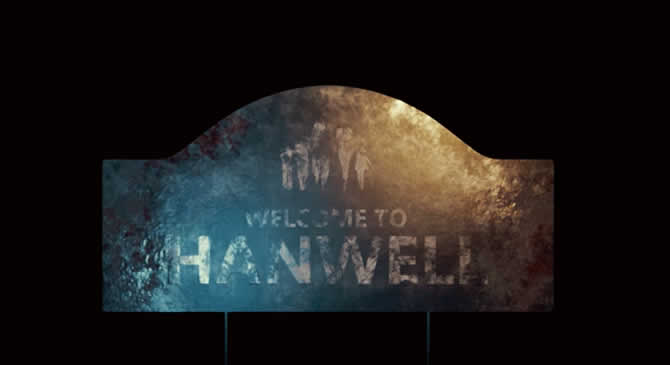
'Beating the Bounds', Aki Schilz.In video games 'Welcome to Hanwell' is a 2017 game. Political representation Hanwell is divided between two: (which covers Hanwell north of the railway line to Paddington), represented since 1997 by, and (south of the railway line), represented since 2007 by.Hanwell is made up of two for elections: Hobbayne and, which both elect councillors to.Hanwell is in the constituency of, which has one assembly member: (Conservative), was re-elected in May 2008 but lost his seat to Dr (Labour) in May 2012.
It is also part of the London region for the elections. The London region elects eight MPs to the European Parliament.Transportation Trams, trolleybuses and motor buses. Tram crossing Hanwell BridgeIn 1901 the first electric began to run along the, causing the population of the village to expand faster than with the arrival of the trains half a century before. First however, the tram company had to strengthen Hanwell Bridge, as well as widen it on its north side. A, which survives to this day, lines each side. Another stipulation placed upon the company was that the standards to support the also had to be able to double as street. The cars cost £1,000 each yet the ordinary fare from to was only 8 d.
Tram in Boston Road, Uxbridge Road is behindA route from to Hanwell was introduced on 26 May 1906.A tram depot (later converted into a trolleybus depot and then into a bus garage) was located on the. It was closed down in 1993 and the land has been converted into a retail park.buses were built at the factory in Windmill Lane and much of the fuel injection equipment and electrical systems were manufactured by who had a factory in. The large Routemaster tyres were moulded and cured, just to the south on the Great West Road in by the whose was opened there in 1928.Trolley buses were introduced in 1936 and ran until the early 1960s.Plans to reintroduce trams in the form of the scheme were suggested, but then abandoned by in 2007 in the face of local opposition.Transport for London: Bus services to and from Hanwell Nearest Underground stations. (, ). (Central line). (Central line)Nearest railway stations., built c. 1875–77, has been declared a Grade II by, but the buildings are now in 'a dilapidated condition'.
It is served by the twice-hourly to service from Monday-Saturday. The train scheme is planned to include a stop at Hanwell railway station, with trains stopping four times per hour in both directions.
and railway stations also serve the town with twice-hourly trains from Monday-Saturday. First Great Western trains to Paddington known by elderly locals as the because when steam trains were used on this line they did not turn around for the return journey but went backwards PUSH.Hanwell residents past and present. And When Did You Last See Your Father?.
Hanwell is made up of 2 wards in the London Borough of Ealing: Elthorne, and Hobbayne. Archived from on 22 February 2014. Retrieved 9 June 2014.
CS1 maint: archived copy as title. Archived from on 22 February 2014. Retrieved 9 June 2014.
CS1 maint: archived copy as title. ^ Neaves, Cyrill (1971). A history of Greater Ealing. United Kingdom: S.
Pp. 103, 105, 128, 208. British-history.ac.uk. ^ Pevsner N B L (1991).
The buildings of England, London 3: North-West. Hanwell: Local government', A History of the County of Middlesex: Volume 3: Shepperton, Staines, Stanwell, Sunbury, Teddington, Heston and Isleworth, Twickenham, Cowley, Cranford, West Drayton, Greenford, Hanwell, Harefield and Harlington (1962),. Retrieved 24 August 2008. West Middlesex branch of CAMRA. Retrieved 23 May 2010. The Fox 31 March 2010 at the.
Retrieved 23 May 2010. Ealing's New Plan for the Environment, volume 2 Chapter 10.10.
Prepared by the Borough, buildings of architectural or historical interest. Retrieved 24 August 2008. M cEwan, Kate (1983). Ealing Walkabout: Journeys into the history of a London borough. Cheshire, UK.: Nick Wheatly Associates.
Pp. 222, 223. Ealing Borough Council (2007).
Pages: 27 & 33. Retrieved 25 August 2008. Roberts, Andrew (1981). Middlesex University web, London.
Retrieved 11 September 2008. A History of the County of Middlesex: Volume 7: Acton, Chiswick, Ealing and Brentford, West Twyford, Willesden (1982) Pages 147–149. Retrieved 11 September 2008. 'Hanwell: ', A History of the County of Middlesex: Volume 3: Shepperton, Staines, Stanwell, Sunbury, Teddington, Heston and Isleworth, Twickenham, Cowley, Cranford, West Drayton, Greenford, Hanwell, Harefield and Harlington (1962), pp.
Retrieved 25 July 2007. Sharpe, Montagu (1926). Some accounts of bygone Hanwell.
Brentford Printing and Publishing Coy., Ltd. Engineering Timelines.
Retrieved 26 December 2018. Ealing Borough Council (2007). Pages 19 Accessed 9 October 2010. English Heritage entry for. Retrieved 2 September 2006. A History of the County of Middlesex: Volume 3: Shepperton, Staines, Stanwell, Sunbury, Teddington, Heston and Isleworth, Twickenham, Cowley, Cranford, West Drayton, Greenford, Hanwell, Harefield and Harlington (1962). Pages 225–226.
Retrieved 11 September 2008. Ealing Council (2008). Retrieved 11 September 2008., Ealing Borough Council.
London Borough of Ealing:Cemeteries. Retrieved 10 November 2010. ^ City of Westminster 14 May 2011 at the.
House of Commons Hansard. Retrieved 8 September 2006. Royal Borough of Kensington and Chelsea.28 November 2010 at the. 'Archaeology: The Pagan Saxon Period', in A History of the County of Middlesex: Volume 1, Physique, Archaeology, Domesday, Ecclesiastical Organization, the Jews, Religious Houses, Education of Working Classes To 1870, Private Education From Sixteenth Century, ed. J S Cockburn, H P F King and K G T McDonnell (London, 1969), pp. British History Online accessed 29 April 2019.
An archaeological watching brief at 75b Studley Grange Road, London Borough of Ealing (9 May 2005). Retrieved 10 November 2010. Sharpe, Montagu (1926). Some accounts of bygone Hanwell. Chapt 3; pages 15 & 16. Brentford Printing and Publishing Coy., Ltd. UK.
Oates, Jonathan (30 September 2002). Southall and Hanwell. The History Press Ltd. 'Archaeology: The Pagan Saxon Period', A History of the County of Middlesex: Volume 1: Physique, Archaeology, Domesday, Ecclesiastical Organization, The Jews, Religious Houses, Education of Working Classes to 1870, Private Education from Sixteenth Century (1969), pp.
Retrieved 10 November 2010. Bosworth, J (1838).
London: Longman, Rees, Orme, Brown, Green, and Longman. P. 60. Field, John (1976). Field-Names of the London Borough of Ealing. English Place-Name Society. Archived from on 25 July 2011. Retrieved 29 April 2011.
CS1 maint: archived copy as title. Circopedia.org. Hanwell Carnival. 25 April 2011 at the. Retrieved 4 June 2020. for Beating the Bounds of Hanwell.
Retrieved 20-06-04. Thefoxpub.co.uk. Ealing Gazette (8 April 2010). Accessed 31 March 2011.
Accessed 5 May 2019. Alex Hayes (12 July 2007). Film Stars Come to Hanwell.
Ealing Times. (PDF).
Archived from (PDF) on 27 September 2007. Retrieved 22 July 2007.
^. – via Project Gutenberg.
Influx Press. Retrieved 25 May 2018.
^ Meads R J (1983). Southall 830 – 1982, page 32. Meads R J (1983).
Southall 830 – 1982, page 54. A History of the County of Middlesex: Volume 3: Shepperton, Staines, Stanwell, Sunbury, Teddington, Heston and Isleworth, Twickenham, Cowley, Cranford, West Drayton, Greenford, Hanwell, Harefield and Harlington (1962), pages 114–119. Retrieved 27 August 2008.
A History of the County of Middlesex: Volume 7: Acton, Chiswick, Ealing and Brentford, West Twyford, Willesden (1982). Pages 101–105. Retrieved 27 August 2008. Retrieved 25 May 2018. English Heritage entry for accessed: 2 September 2006. Deep Purple Appreciation Society accessed: 8 September 2006. Musicians Hotline accessed: 30 September 2006.
A History of the County of Middlesex: Volume 3: Shepperton, Staines, Stanwell, Sunbury, Teddington, Heston and Isleworth, Twickenham, Cowley, Cranford, West Drayton, Greenford, Hanwell, Harefield and Harlington (1962). Retrieved 1 June 2007. A History of the County of Middlesex: Volume 3: Shepperton, Staines, Stanwell, Sunbury, Teddington, Heston and Isleworth, Twickenham, Cowley, Cranford, West Drayton, Greenford, Hanwell, Harefield and Harlington (1962).
Retrieved 1 June 2007.External links., A History of the County of Middlesex: Volume 3:, and, Hanwell, and (1962), pp. 220–24. Retrieved 24 June 2006.Wikimedia Commons has media related to.
Hanwell, once a safe haven from the horrors of the world, now a cesspit of anomalous scum. Explore a dense open world of terror, every building a unique location with its own story to tell. Strung together by the remnants of Hanwell.There is something deeply unsettling about Hanwell.
Unexplained noises, something in the corner of your eye or laying just beyond the shadows create an atmosphere that will keep you constantly on edge.Monsters roam the streets. They occasionally get into the once protected buildings. What you do with them is up to you, be resourceful and pick up whatever you can find in order to fight them. And don't look back.There is an entire city to explore, featuring different environments each more distinct than the last. From residential homes, old English pubs, parks, stores, supermarkets and government buildings, all the way to the infamous HCPP research center. Each location holds its own backstory, leading to your arrival.Jump in, turn out the lights and discover the terrifying world of Hanwell.Show more. Submitted on Review title of Baffled DadNicer in reality.(just.)The real Hanwell(ealing,Greater london) is thankfully nothing like this in reality, and I'm guessing the devs have some long standing issues with the place and the council that runs it.with scary sandbox surprises like the witch that keeps blocking your escape and a shapeless form that robs you of nearly all your vision, forcing you to ping a radar type device briefly revealing your surroundings, (overuse attracts other anomalous beasties) there are some good ideas here,bags of atmosphere and a slow paced plot to creep through.
Puzzles are simple,combat consists of clunky,inaccurate melee strikes with classically skinned weapons.red crowbar anyone? Graphics are generally pants, muddy textures, over repetition of assets, though the enemies are animated well enough, and im enjoying the enviromental storytelling. Needs a bit more polish(maybe more than 2 car models for a start),but at 12 or so quid it wont break the bank, and the jumpscares work well enough.
Submitted on Review title of medium blokeIt's just not that goodBadly mapped out control scheme that you can't change, repetitive musical sounds, glitched audio, bad voice acting, no settings to disable the trigger vibrations, the combat is terrible and makes fighting extremely clunky and difficult, and the 'sprint' speed should be the normal moving speed, you can't get away from anything. To top it all off, despite the 'meh' graphics and relatively small maps, the devs still couldn't make this game run smooth, you'd be lucky to get 25 FPS. I get that it's an indie title by a small team, but at the price they ask for this game, I'd expect them to at least be able to get this to run at 30 FPS and have a basic settings menu. If you're looking for well made horror games for similar prices, look up SOMA or Amnesia. Submitted on Review title of Darth VirususJust awful DON'T WASTE YOR MONEYJust terible,clearly whoever made this game has never visited the uk the design is terrible, repeating ding ding music that is annoying, the fact that everytime you enter a building / loading screen it changes your look inversion controls, it looks and plays like a N64 game, DON'T waste your money on this i really wish i could get a refundI never review games but this one so bad i had too, it was a terrible rip off of slender man but just.